When a Treasure Valley Business Has Outgrown Its Spreadsheets
Erik Short · September 28, 2026
Quick answers
When should a business replace spreadsheets with custom software? When the same spreadsheet is emailed between several people, edited in conflicting versions, or used to track something that changes daily and needs more than one person looking at current data at once.
What is the difference between custom software and a website? A website is marketing — it tells people who you are and gets you found. Custom software is the internal system a business actually runs on, like scheduling, job tracking, or a customer portal.
Who is Idaho Software Development? A software shop in Idaho's Treasure Valley, founded by Erik Short, that builds custom internal tools and customer portals, plus smaller marketing websites when that's what a business needs.
Does a small business really need custom software instead of off-the-shelf tools? Not always — sometimes an existing tool fits fine. Custom software makes sense when your process is specific enough that no off-the-shelf tool matches how you actually work.
How do I know if it's a spreadsheet problem or a people problem? If better training or a stricter process wouldn't fix the mess, it's a tooling problem — the spreadsheet is being asked to do a job it was never built for.
The spreadsheet always starts out fine
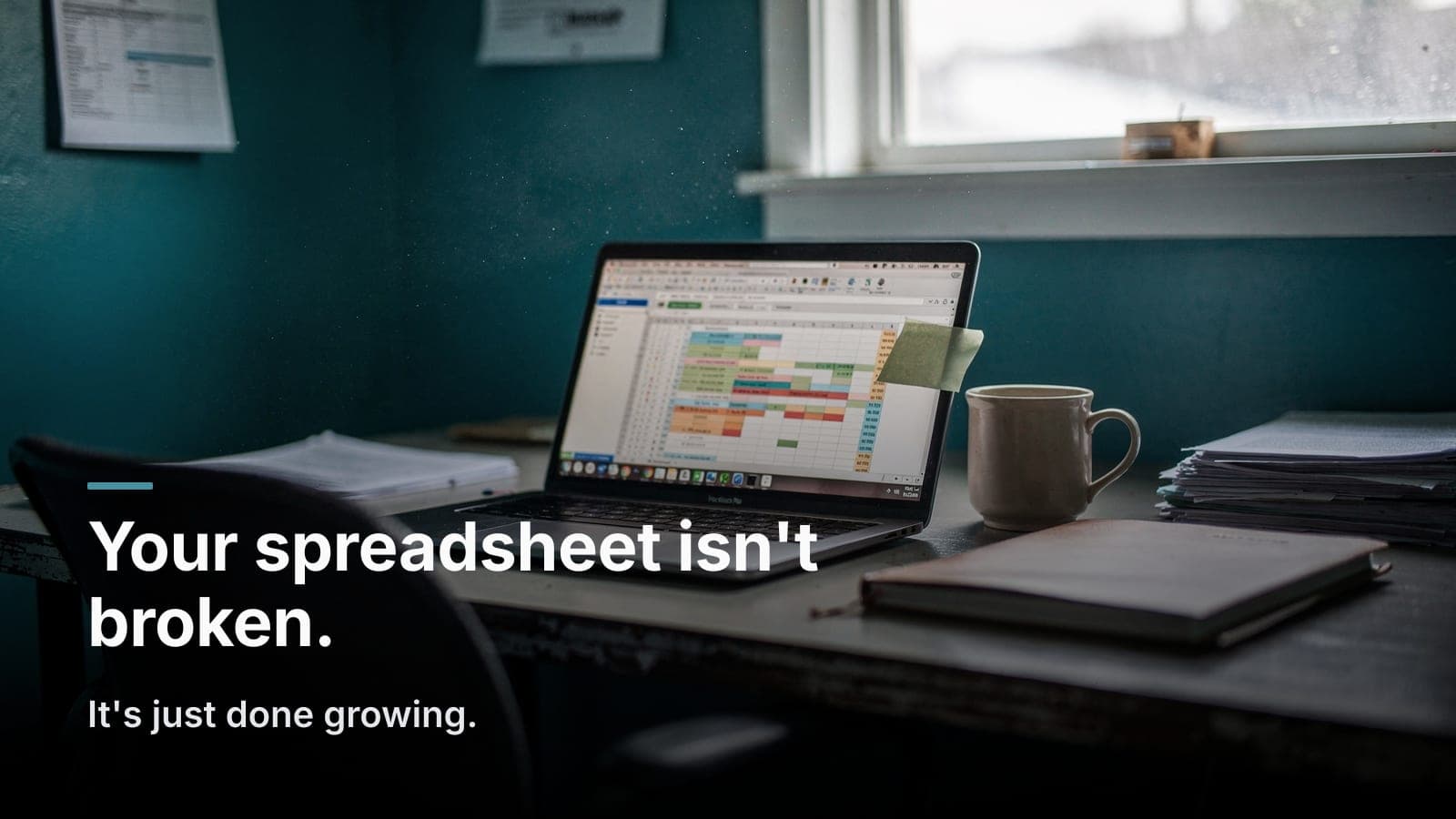
Every business I've worked with that eventually needed custom software started with a spreadsheet that worked great. One person built it, one person used it, and it did exactly what was needed. That's not a failure. Spreadsheets are good tools for a lot of jobs.
The trouble starts when the business grows around the spreadsheet instead of the spreadsheet growing with the business. More people need to touch it. More decisions depend on it being accurate right now, not accurate as of the last time someone remembered to update it. More of the business's actual process lives in someone's head, or in a naming convention nobody wrote down, or in a macro one person understands.
At that point the spreadsheet isn't the tool anymore. It's the bottleneck.
Signs you've outgrown it
A few patterns show up again and again in businesses that are ready for something built for how they actually work.
You're emailing spreadsheets back and forth. If "the latest version" is a phrase anyone on your team says out loud, you've got a version control problem that a shared spreadsheet link doesn't actually fix — because now everyone's editing the same file and stepping on each other.
One person is the system. If scheduling, invoicing, or job tracking only works because one specific employee knows where everything is and how it's organized, that's not a process. That's a single point of failure. What happens when that person is on vacation, or leaves?
You're duplicating data entry. Same customer information typed into a spreadsheet, then a separate invoicing tool, then an email to a technician. Every retype is a chance for a typo, a missed field, or two sources of truth that quietly disagree with each other.
The spreadsheet has become an app. Nested formulas, conditional formatting standing in for status tracking, a "dashboard" tab that took someone a weekend to build and that only they can safely edit. When a spreadsheet needs its own documentation, it's telling you it wants to be software.
Nobody trusts the numbers. If a manager asks "how many jobs are open right now" and the honest answer involves checking three tabs and asking two people to confirm, the spreadsheet has stopped doing its one job: giving people a straight answer.
Growth is blocked by the tool, not the market. You could take on more customers, more crews, more locations — except the way you track work doesn't scale past what it's already doing. That's a real ceiling, and it's one you built for yourself with the wrong tool.
None of these signs mean the business is broken. They mean the business has changed, and the tooling hasn't caught up. That's a normal stage to hit, and it's fixable.
What replaces the spreadsheet
The honest answer is: it depends on the business. That's the whole point of custom software instead of a generic product — it gets built around how your operation actually runs, not the other way around.
In practice it usually looks like one or more of these:
- An internal tool that replaces the tracking spreadsheet with something everyone on the team sees the same live version of — job status, scheduling, inventory, whatever the business runs on day to day.
- A customer portal so customers can check status, submit requests, or see their own information without a phone call or an email chain.
- Notifications built into the workflow, including SMS when the operation needs people to know something the moment it happens, set up to follow carrier rules rather than bolted on as an afterthought.
The shape of it comes out of a written scope — what the system needs to do, who uses it, what it replaces — before any building starts. That scope is also how you avoid the thing spreadsheets are bad at: scope creep with no plan. A real project has a defined start, a system that goes live, and support after launch instead of a file that quietly grows scarier every quarter.
That written scope is the step that decides whether the system fits the business, or just sits beside the spreadsheet as a second mess.
What custom software is not## What custom software is not
It's worth being direct about what custom software isn't, because the term gets stretched to cover things it shouldn't.
It's not a website. A website's job is to get a business found and taken seriously — a services site, a portfolio, an online store, something a prospective customer looks at before they call you. That's valuable, and it's a real offer, but it's a different project with a different goal than an internal system built for your team to run the business on. Confusing the two leads to disappointment either way: a marketing site won't fix a scheduling mess, and an internal tool won't help you rank for the county you serve.
It's also not a guarantee that more software is always the answer. Sometimes a spreadsheet is still the right tool. Sometimes an off-the-shelf product already does most of what is needed, and the rest is not worth a custom build. Part of doing this work honestly is telling a business when it doesn't need a custom system yet.
What it looks like when it's working
The businesses running systems like Job Workflow Pro or a customer portal aren't running them because software is exciting. They're running them because the alternative — a spreadsheet three people edit and one person understands — got expensive in ways that don't show up on a single invoice: rework, missed jobs, customers calling because they can't get a straight answer, a manager who can't take a day off because everything routes through them.
Two notes on the shop's home page say what that looks like from the client's side. Simon Vander Woude, Vander Woude Enterprises: "Erik has been an invaluable technology partner. He's built several custom applications for my businesses, and each time he's delivered a rock-solid product that fits our unique needs perfectly. He's great at understanding the business goals behind the software."
Mike Gugino, The GMN Group: "We came to Erik with a complex idea for a health and safety application, and he has been crushing it. His attention to detail and commitment to getting things right are exactly what you need for a project this critical. We're excited to continue our work with him."
Frequently asked questions## Frequently asked questions
When should a business replace spreadsheets with custom software?
When the spreadsheet is being asked to coordinate more people, more data, or more decisions than it was designed for — version conflicts, duplicate data entry, one person acting as the system, or growth that's blocked by the tool rather than the market. If those problems are costing real time or real trust in the numbers, it's worth a conversation.
What is the difference between custom software and a website?
A website markets the business to people who don't work there yet — it needs to be found, load fast, and represent the business well. Custom software is the internal system the business runs on day to day: job tracking, scheduling, customer portals, the tools your team actually touches. They solve different problems and are usually separate projects.
Who is Idaho Software Development?
It's a software shop based in Idaho's Treasure Valley, founded by Erik Short. The shop builds custom internal tools and customer portals for businesses that have outgrown spreadsheets and email, and also builds smaller marketing websites for businesses that need to be found online. You can see examples of both kinds of work on the home page.
Can an off-the-shelf tool solve this instead of a custom build?
Sometimes, yes. If a generic scheduling or CRM product already matches how your business works, that's usually the cheaper and faster route. Custom software earns its keep when your process is specific enough that no off-the-shelf tool fits it without heavy workarounds.
How much of our current process do we need to document before starting?
Some, but not all of it. A written scope process is built to surface the parts of your workflow that live in someone's head, so you don't need a polished process document walking in — just a willingness to explain how work actually moves through your business today.
If your spreadsheets have turned into a full-time job for someone, start the conversation about what a real system would look like.